IPTV Spain: Best IPTV Subscription in Spain (2026 Guide for Safe & Smooth Streaming)
What Is IPTV in Spain? (Simple Explanation for Beginners)
IPTV in Spain simply means watching live TV channels and on-demand content through the internet instead of a traditional satellite dish or cable box. In practical terms, you’re using your home Wi-Fi (or mobile data) to stream TV on devices you already own — like a Firestick, Android TV box, Smart TV, or even a phone. For most people, the reason IPTV has become so popular is simple: it’s more flexible than classic TV, usually offers more international content, and works across multiple screens.
A typical real-life example: someone living in Madrid wants Spanish channels, sports, and a few international movie channels, but they also want the same service on a Firestick in the living room and an Android phone while traveling. With IPTV, that’s possible — you just log in with the same subscription details. Many services also include features like an EPG (electronic program guide), catch-up TV, and VOD (video on demand). Best IPTV Apps for Spain (2026): Firestick, Android & Smart TV. These features matter because they change IPTV from “random links” into something that feels like a normal TV experience.
A point that confuses beginners is the wording. People search “IPTV Spain” when they want a service that works well inside Spain and includes Spanish content. People search “Spain IPTV” when they want the same thing but phrase it differently — usually in a more commercial, buyer-intent way. That’s why you’ll also see queries like “best IPTV Spain” and “IPTV subscription Spain”: users aren’t asking what IPTV is anymore, they’re trying to choose a provider without wasting money.
If you’re new, the easiest way to think about IPTV is as a bundle of three things: the content (channels and VOD), the app you use to watch it (on Firestick, Android, or Smart TV), and the quality of the server behind it (which affects buffering). A beginner-friendly decision tip is to test the service at peak hours (evenings and weekends), because that’s when weak services collapse. IPTV Not Working in Spain? Common Problems and Practical Fixes .Also, make sure the service supports the devices you actually use in Spain and across Europe, and check whether it includes the Spanish channels you care about rather than an inflated channel count.
IPTV Spain vs Spain IPTV: what people really mean
“IPTV Spain” and “Spain IPTV” are essentially the same search — but they usually signal slightly different intentions. When someone types IPTV Spain, they’re often in learning mode: they want to understand how IPTV works in Spain, what devices are supported, and whether the experience is smooth for Spanish networks. When someone searches Spain IPTV, they’re usually closer to buying: they want options, pricing, and a service that feels “made for Spain” without technical headaches.
A simple real-world scenario makes this clearer. A user in Barcelona might search IPTV Spain because they want Spanish channels, sports, and a stable stream on a Firestick. Another user living in Germany but traveling to Spain might search Spain IPTV because they want the same subscription to work across Spain and Europe, without buffering or app issues. Both people want the same outcome — but one is asking “what is this and how does it work?” while the other is asking “which one should I choose?”
This difference matters because it affects what you should check before paying for an IPTV subscription Spain. If you’re still in the research phase, focus on compatibility and setup: does the service work smoothly on Android TV, Smart TVs, and mobile? Does it include an EPG and a clean channel layout? If you’re closer to purchase, focus on reliability and support: how fast do they respond, do they offer a trial, and do they provide clear setup instructions for non-technical users?
A practical tip: don’t get distracted by keyword variations. Whether the service calls itself “Spain IPTV” or “IPTV Spain,” the real quality comes down to performance during peak hours, Spanish channel availability, and device support. A premium service will feel consistent on your home Wi-Fi, will not collapse on weekends, and will guide you through setup without pushing you into confusing technical steps. The living-room setup most users want is simple: one subscription, one app, and stable streaming on the TV.
How to Choose the Best IPTV Spain Service (What Matters Most)
The best way to choose a reliable IPTV service in Spain is to ignore the marketing claims and judge it like a real product: streaming stability, content that actually matches your needs, and support that helps you set it up without stress. Most people don’t fail because they “picked the wrong channels” — they fail because the service buffers at night, doesn’t work on their device, or disappears the moment something breaks. A good choice feels boring in the best way: it works every day, on every screen, without constant troubleshooting.
Start with reliability, because this is what separates a premium experience from a frustrating one. A service can have 20,000 channels and still be useless if it freezes during peak hours. If you’re in Spain, test the stream in the evening and on weekends, when networks are busy and weaker providers struggle. Also check how fast channels load and whether switching between channels feels smooth. If the provider offers a trial, that’s not just a “nice extra” — it’s one of the best decision tools you have.
Next, focus on usability and device compatibility. Most non-technical users in Spain stream on Firestick, Android TV, or Smart TVs, and they want something simple: a clean app, an EPG that loads correctly, and a clear setup process. Best IPTV Apps for Spain (2026): Firestick, Android & Smart TV .If a provider cannot explain setup in a few simple steps, that’s usually a sign the support will be poor later. Look for features that actually matter: catch-up TV, stable VOD, and multi-device support if your household watches on more than one screen.
Finally, learn the red flags that often lead to wasted money. Be careful with providers that promise “perfect 4K” everywhere, refuse to offer any trial, or push you into risky payment methods without transparency. Another warning sign is vague customer support: if you can’t reach them before you pay, you probably won’t reach them after you pay. The safest approach is to choose a service that is clear about what you get, supports the devices you use, and gives you a realistic way to test performance before committing long-term.
Streaming quality, channels, EPG, and device support
If you want IPTV that feels premium in Spain, you should judge it on four practical pillars: streaming quality, channel relevance, a working EPG, and real device support. Most people make the mistake of focusing only on “how many channels” a service claims to offer. In reality, the best experience comes from stability and usability. A smaller but well-organized channel list that loads instantly will always beat a huge list that buffers, crashes, or forces you to fight the interface every night.
Streaming quality is not just about HD or 4K labels. What matters is whether the stream stays smooth during peak hours, especially in the evenings and on weekends when many users in Spain are watching sports or popular live channels. A good service should load channels quickly, switch without delays, and stay stable even when your home network isn’t perfect. If you’re testing a provider, try the same channel on different devices (for example Firestick and Android TV) to see if the experience stays consistent. This is also where a proper trial becomes valuable: it’s the only honest way to measure real performance.
Channels matter, but only if they match your household. Many people searching IPTV subscription Spain want Spanish national channels, regional channels, sports, and movie content — plus a few international options. Instead of chasing “20,000+ channels,” check whether the service actually includes what you watch weekly. The same logic applies to VOD: a massive library is useless if it’s poorly organized, outdated, or full of broken titles. A quality provider will have clean categories, stable playback, and content that loads quickly without constant errors.
EPG and device support are where many services fail. An EPG should load reliably, show correct schedules, and make live TV feel normal instead of chaotic. Device support should be realistic: does it work smoothly on Firestick, Android TV, and Smart TVs? Is setup simple for non-technical users? If a service can’t guide you through setup clearly, you will likely struggle later when something breaks. In 2026, IPTV should feel like a polished streaming service not a technical project.
Red flags to avoid when buying an IPTV subscription Spain
The biggest mistake when buying an IPTV subscription Spain is trusting the marketing instead of checking the warning signs. A bad provider can look professional on the surface, but the experience quickly becomes frustrating: buffering during sports, channels that disappear, an EPG that never loads, and support that stops replying after payment. The good news is that most low-quality services follow the same patterns, so once you know the red flags, you can avoid wasting money.
The first red flag is unrealistic promises. If a provider guarantees “zero buffering,” “perfect 4K on every channel,” or claims their service is “the #1 best IPTV Spain” without showing any real proof, treat it as marketing noise. Streaming depends on servers, networks, and peak-time demand — even premium services can have occasional issues. Another warning sign is a channel list that sounds too good to be true, like “30,000 channels + 200,000 VOD.” Often these lists are inflated, duplicated, or filled with broken streams. A smaller, well-curated selection with stable playback is usually the safer choice. Best IPTV Spain (2026): Tested Services Based on Real User Experiences
The second red flag is poor transparency around trials, refunds, and support. A serious provider should offer some way to test the service or at least explain clearly what happens if it doesn’t work on your device. If the seller refuses any trial, pushes you into a long-term plan immediately, or avoids answering basic questions about Firestick, Android TV, or Smart TV setup, you should walk away. Support quality matters more than people expect, because IPTV is not “set and forget” — even good services sometimes require small fixes, and you need someone who can help quickly.
The third red flag is risky payment behavior and aggressive selling. Be careful if the provider only accepts unusual payment methods, demands payment through anonymous channels, or changes prices depending on how you respond. Also watch out for fake urgency: “Only today,” “last 10 accounts,” or pressure to pay fast. A premium IPTV provider does not need to rush you. They should make the buying process calm, clear, and predictable, especially for non-technical users in Spain and across Europe.
A final practical tip: before paying, ask one simple question and judge the response speed and clarity. For example: “Does this work on Firestick and Android TV, and does the EPG load reliably in Spain?” If the answer is vague, copy-pasted, or slow, that tells you what support will feel like later.
Best IPTV in Spain: What a Good IPTV Subscription Should Include
A good IPTV subscription should feel like a complete, stable TV service — not a messy collection of links. The difference between an average provider and a truly premium one is not the number of channels, but the overall experience: reliable streaming, a channel lineup that makes sense for Spain, and features that help you watch comfortably on the devices you already use. If you’re choosing a service for your home, the goal is simple: you should be able to turn on the TV and watch without troubleshooting every week.
The first thing a quality service should include is consistent streaming performance in Spain and across Europe. That means fast channel loading, smooth switching, and stability during peak hours. A serious provider should support HD for most channels, and only offer 4K where it actually works. It should also perform well on common setups like Firestick, Android TV, and Smart TVs. If the service feels smooth on one device but constantly buffers on another, that’s usually a sign of weak optimization or overloaded servers.
Next, a good IPTV package should include content that matches real viewing habits. For most users, that means Spanish national channels, sports, movies, and popular entertainment — plus optional international content for families living abroad or multilingual households. A well-built service also organizes content properly: categories are clean, VOD libraries are usable, and channels are not duplicated five times with random names. This is one of the easiest ways to spot quality: if the channel list looks chaotic, the service usually is.
Finally, premium IPTV includes the “small” features that make the experience feel normal: a working EPG, catch-up TV where available, and support that can actually help you. Many users don’t realize how important EPG is until it breaks — without it, IPTV becomes frustrating to navigate. A good provider should also offer a trial or at least a clear testing option, so you can check performance before committing. And if you’re non-technical, the service should include clear setup steps, quick support replies, and guidance for the best apps to use.
Spanish channels, sports, movies, and international options
A good IPTV service for Spain should match what people actually watch: Spanish live channels, reliable sports streams, a solid movie and series library, and international options for families and expats. The biggest difference between a “random IPTV list” and a premium service is relevance. It’s not about having thousands of channels — it’s about having the right ones, organized properly, and stable enough to watch without constant buffering or broken links.
For most users, the core requirement is Spanish national TV and popular entertainment. That means the channels people use daily: news, general entertainment, kids content, and regional programming. If you live in Spain, it’s also important that the service is optimized for Spanish networks and peak-time viewing, because the same IPTV package can behave very differently depending on where you are. A strong provider will offer clean categories (Spain, sports, movies, international) so you don’t waste time scrolling through clutter.
Sports is where quality gets tested. Many people search best IPTV Spain mainly because they want football and major events to work smoothly, especially on weekends. A reliable service should handle high demand without freezing, and it should offer stable streams rather than ten duplicate links that all fail. Practical tip: when testing a provider, try sports channels during real match times. If the service struggles then, it will not suddenly improve after you pay for a longer plan.
Movies and series matter too, but usability is the key. A huge VOD library is pointless if it’s messy, slow, or filled with broken titles. Look for clear categories, search functionality, and stable playback. For international households, language options can be just as important as the content itself. Many users in Spain want channels from the UK, Germany, France, Italy, or Arabic-speaking countries, and the best providers make this easy without burying everything in one massive list.
Finally, consider how your household watches. Some people mainly stream on a Firestick, others use Android TV, and many families mix Smart TVs and mobile devices. Best IPTV Apps for Spain (2026): Firestick, Android & Smart TV .A good IPTV subscription Spain should support this reality with flexible access and a channel lineup that stays consistent across devices. The best service is the one that fits your viewing habits, not the one with the biggest numbers.
Monthly vs yearly plans: what’s safer and smarter
The safest choice for most people is to start with a monthly plan, test performance properly, and only then consider a longer subscription. Yearly plans can be cheaper, but they come with a bigger risk: if the service becomes unstable, changes servers, or support disappears, you’ve already paid for months you may not use. This is especially important for non-technical users in Spain, because the “cost” of a bad plan is not only money — it’s also wasted time and constant frustration.
A realistic scenario: someone buys a yearly plan because the price looks like a great deal, but after two weeks the service starts buffering during peak hours. Now they’re stuck trying to fix issues, chasing support, and hoping the provider improves. In contrast, a monthly plan gives you freedom. You can test the service during evenings, weekends, and sports events, and you can see whether the EPG works consistently on your device. If everything stays stable for a full month, that’s a much stronger signal than any marketing claim.
That said, yearly plans are not always a bad choice. They can be smart if the provider has already proven itself, offers consistent support, and delivers stable quality across your main devices (Firestick, Android TV, Smart TV). The key is trust built through experience. A good middle option is often a 3-month plan, because it offers some savings while keeping your risk lower than a full year. If you’re choosing for a family household, this balance matters even more, because the service will be used daily and problems will become annoying fast.
A practical decision rule is simple: pay long-term only after you’ve tested short-term. Before upgrading, check three things: peak-hour stability, channel reliability (especially sports), and support response speed. If any of these feel weak, don’t lock yourself into a yearly plan. A premium IPTV subscription should earn long-term commitment by being consistently reliable, not by offering the biggest discount.
Spain IPTV Setup: Works on Firestick, Android, and Smart TVs
Setting up IPTV in Spain is usually straightforward as long as you use the right device and a stable app. Most users don’t need advanced technical steps — the goal is simply to install an IPTV player, enter the login details provided by the service, and test streaming quality. The most important thing is choosing a setup that fits your home: Firestick is the easiest for most people, Android TV is flexible, and Smart TVs can work well if the app support is solid.
Firestick is popular because it’s simple, fast, and works reliably with most IPTV apps. A common scenario is a household in Spain using one Firestick in the living room and another in a bedroom, both connected to the same subscription. Setup is usually: install an IPTV app, enter your playlist or credentials, load channels, and test. The key tip is to check performance during peak hours and make sure the EPG loads correctly, because that’s where weaker services show problems.
Android TV (and Android boxes) are another strong option, especially if you want more flexibility and better control over apps and playback settings. Android is often the best choice for users who want smoother performance and the ability to switch IPTV players if one app feels slow. Smart TVs can also work well, but the experience depends heavily on the TV brand and the app store. Some Smart TVs run IPTV apps smoothly, while others feel slow, crash, or struggle with EPG and channel switching. If your Smart TV is older, a Firestick or Android TV box often gives a much better experience.
A practical setup rule is this: keep it simple and optimize your home network. Use 5GHz Wi-Fi when possible, keep your streaming device close to the router, and avoid running too many heavy downloads while watching live TV. If you want IPTV to feel premium, the best setup is the one that requires the least troubleshooting. A good provider should also offer clear setup steps and support, so you’re not left guessing when something doesn’t work.
Fast setup overview (non-technical)
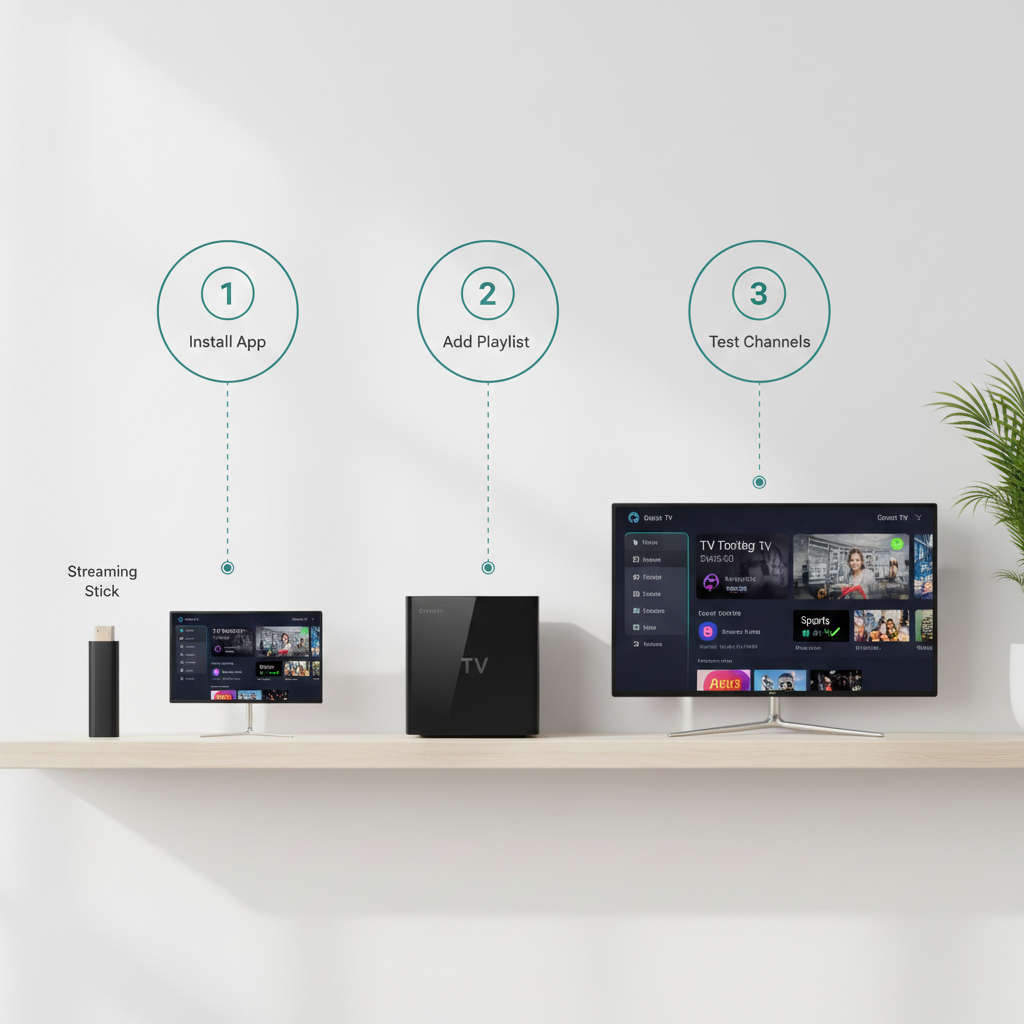
Setting up IPTV is usually a 10–15 minute job if you follow a simple order: choose your device, install one reliable IPTV app, add your subscription details, and test a few channels. You don’t need technical knowledge, and you don’t need to change complicated settings. The biggest mistake beginners make is installing random apps or trying multiple setups at once, which creates confusion and makes it harder to know what’s actually working.
The simplest setup for most homes in Spain is a Firestick or Android TV device connected to your main TV. After you install the IPTV app, your provider will typically give you one of two things: a username/password login or a playlist link. Best IPTV Apps for Spain (2026): Firestick, Android & Smart TV .You enter that inside the app, let it load channels and the EPG, and then you test. A good test is to try live TV, switch between channels, open the program guide, and play one VOD title. If those basics work smoothly, you’re already 80% done.
If something feels slow or buffers, don’t panic and don’t assume the service is always bad. First, check your Wi-Fi and device setup. For best results, use 5GHz Wi-Fi if available, keep the streaming device close to the router, and restart the device once after setup. Also, avoid installing too many “cleaner” apps or extra tools, because they often cause more problems than they solve. Most IPTV issues in Spain are caused by weak Wi-Fi signals, overloaded servers at peak times, or using an app that isn’t stable on your device. IPTV Not Working in Spain? Common Problems and Practical Fixes
A practical tip is to keep your setup minimal and repeatable. One good app, one main device, and a clear way to contact support if needed. If you plan to watch on multiple screens, set up the living room TV first, confirm everything works, and only then add a second device like a Smart TV or phone. That approach prevents the common beginner problem: everything half-working and no clear way to fix it.
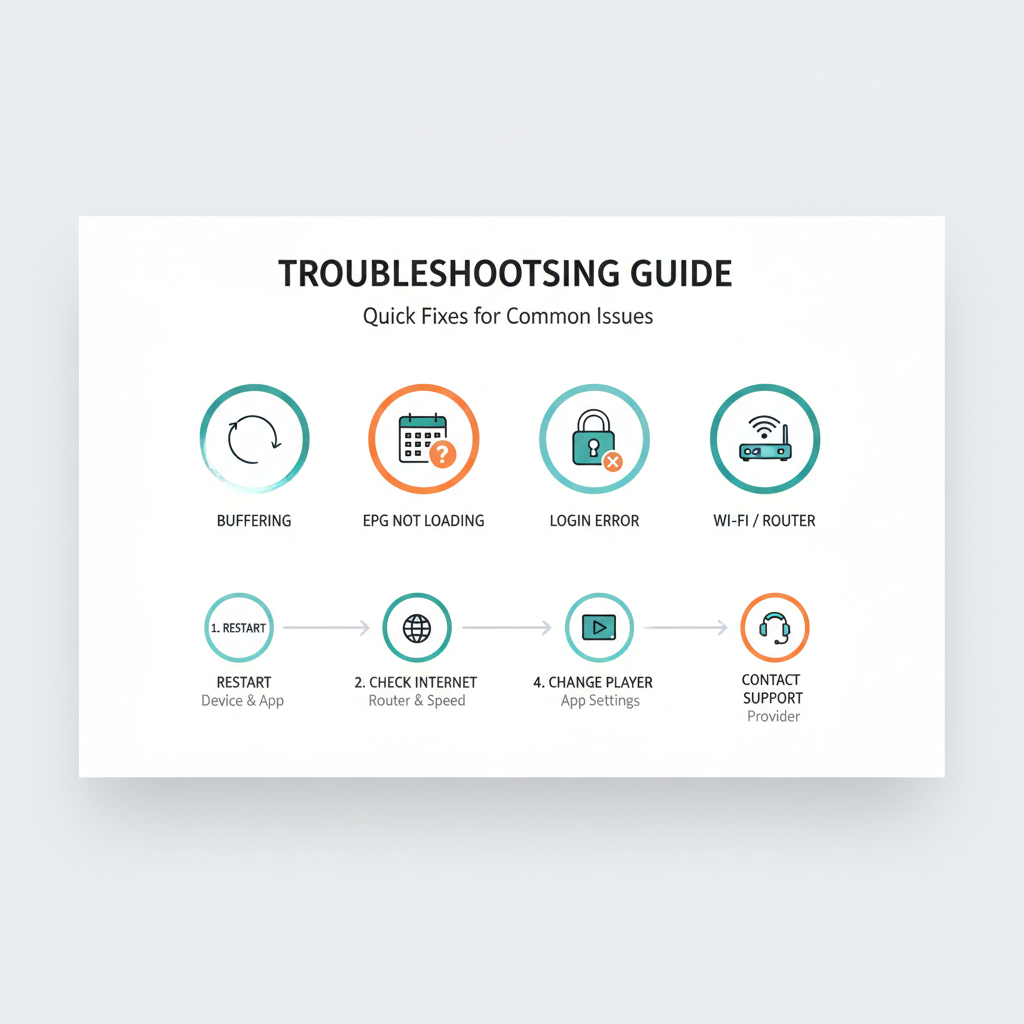
IPTV Not Working in Spain? Fixes for Buffering, EPG, and Errors
If IPTV is not working in Spain, the problem is usually one of three things: buffering caused by network or server load, an EPG that fails to load correctly, or login/playlist errors inside the app. The good news is that most issues are fixable in a few minutes without technical skills. The key is to troubleshoot in the right order, so you don’t waste time changing random settings or blaming the wrong part of the setup.
Buffering is the most common complaint, especially during evenings and weekends. Before assuming the service is “bad,” check the basics: restart your streaming device, restart your router, and test a few different channels. If only one channel buffers, it’s often a channel-source issue. If everything buffers, it can be Wi-Fi signal strength, peak-time server overload, or using a weak IPTV app on your device. A simple improvement for many homes is switching from Smart TV apps to a Firestick or Android TV device, because these usually handle IPTV more smoothly.
EPG problems are also common, and they can make IPTV feel unusable even when channels play fine. If the guide is blank, wrong, or stuck loading, first refresh it inside the app, then check whether the service provides a working EPG source. Some providers deliver a poor guide or update it inconsistently. Another practical fix is switching to a different IPTV player that handles EPG better, because some apps are simply more reliable than others. If the guide works one day and breaks the next, it’s often a provider-side issue rather than your internet.
Login and playlist errors usually happen when details are entered incorrectly or when the service changes something on their side. If you see messages like “authorization failed,” “invalid URL,” or “playlist error,” double-check the login format and avoid copying extra spaces. If the same details worked yesterday but fail today, contact support and ask if your account is active and whether the server address has changed. A quality provider should respond clearly and guide you through the fix without asking for unnecessary personal information.
The fastest way to solve most issues is to test systematically: check your Wi-Fi, test on a second device if possible, and try a different IPTV app if the current one feels unstable. IPTV should not require constant tweaking. If problems repeat every week, it’s usually a sign the service is overloaded or low quality, and switching providers may be the smarter solution.
Most common problems + quick practical solutions
The most common IPTV problems are surprisingly predictable: buffering, channels not loading, EPG issues, and login errors. The important thing is not to panic or start changing random settings. In most cases, the fastest solution is to test in a simple order: restart the device, check the internet connection, and then isolate whether the issue is your home network, the IPTV app, or the provider’s server. When you troubleshoot step-by-step, you can usually fix the problem in minutes.
Buffering and freezing are the #1 issue, especially in the evenings. A quick fix is to restart your router and your streaming device, then test a few channels. If only one channel buffers, it’s often a source problem and not your internet. If everything buffers, try moving closer to the router, switching to 5GHz Wi-Fi, or testing with a wired connection if your device supports it. Another common fix is changing the IPTV player, because some apps handle streams better on Firestick or Android TV than others. If buffering happens mainly during big sports events, the provider may simply be overloaded.
EPG problems come next. If the guide is blank, slow, or shows wrong schedules, first refresh it inside the app and wait a few minutes. Many apps also have an “update EPG” option that forces a reload. If it still fails, test the same subscription on a different IPTV app. This quickly shows whether the issue is the app or the provider. A lot of services technically offer EPG, but it’s poorly maintained, so it breaks frequently. In that case, the only real solution is using a better app or choosing a higher-quality provider.
Login errors and playlist issues are usually caused by small mistakes. If you see “authorization failed” or “invalid URL,” copy the details again carefully and avoid extra spaces. If you use a playlist link, make sure it is complete and hasn’t expired. If the same login worked yesterday and suddenly fails, contact support and ask if the server address changed or if your account was paused. A serious provider should respond quickly and confirm the status without asking for sensitive personal data.
A practical rule: if the same problems repeat every week, the service is probably the issue — not you. IPTV should feel stable and predictable, especially on common setups like Firestick, Android TV, and Smart TVs. If you’re constantly fixing buffering, broken channels, or EPG failures, it may be smarter to switch to a provider with better stability rather than spending more time troubleshooting.
Final Checklist: Before You Buy IPTV Spain
Before you buy any IPTV service, you should do one thing: slow down and check the basics that decide whether the experience will be smooth or frustrating. Most people regret their purchase for predictable reasons — buffering at night, missing Spanish channels, an EPG that never works, or support that disappears after payment. A short checklist helps you avoid the common traps and choose a provider that fits your home, your devices, and your viewing habits.
Start with performance and reliability. If the provider offers a trial, use it during real peak hours, not just in the morning. Test live TV, switch channels quickly, and check whether the stream stays stable for at least 15–20 minutes. Sports fans should always test during match times, because that’s when weak servers collapse. If there is no trial at all, that’s already a warning sign, especially if they push you into a yearly plan. A serious service should be confident enough to let you test.
Next, check usability: device support, app compatibility, and EPG. Most users in Spain watch on Firestick, Android TV, or Smart TVs, and you want a setup that feels simple. Best IPTV Apps for Spain (2026): Firestick, Android & Smart TV .The service should work on your exact device, not “in theory.” The EPG should load and show correct schedules, because without it, IPTV becomes annoying to navigate. Also check whether the provider gives clear setup instructions. If their setup guide feels confusing, the support will likely be worse when you actually need help.
Then confirm the content matches your household. Don’t chase huge channel counts. Verify Spanish channels you care about, sports coverage, movie/series options, and any international channels your family needs. If possible, scroll through categories and see whether they are clean and organized. A messy list with duplicated channels is often a sign of low quality. Finally, check payment safety and support responsiveness. A good provider answers questions clearly, offers predictable pricing, and does not pressure you with fake urgency.
Mini-checklist (quick scan):
- Trial available and works at peak time
- Stable streams + fast channel switching
- Spanish channels you actually watch
- EPG loads correctly
- Works on your device (Firestick/Android/Smart TV)
- Support replies clearly before payment
- Monthly option available before yearly
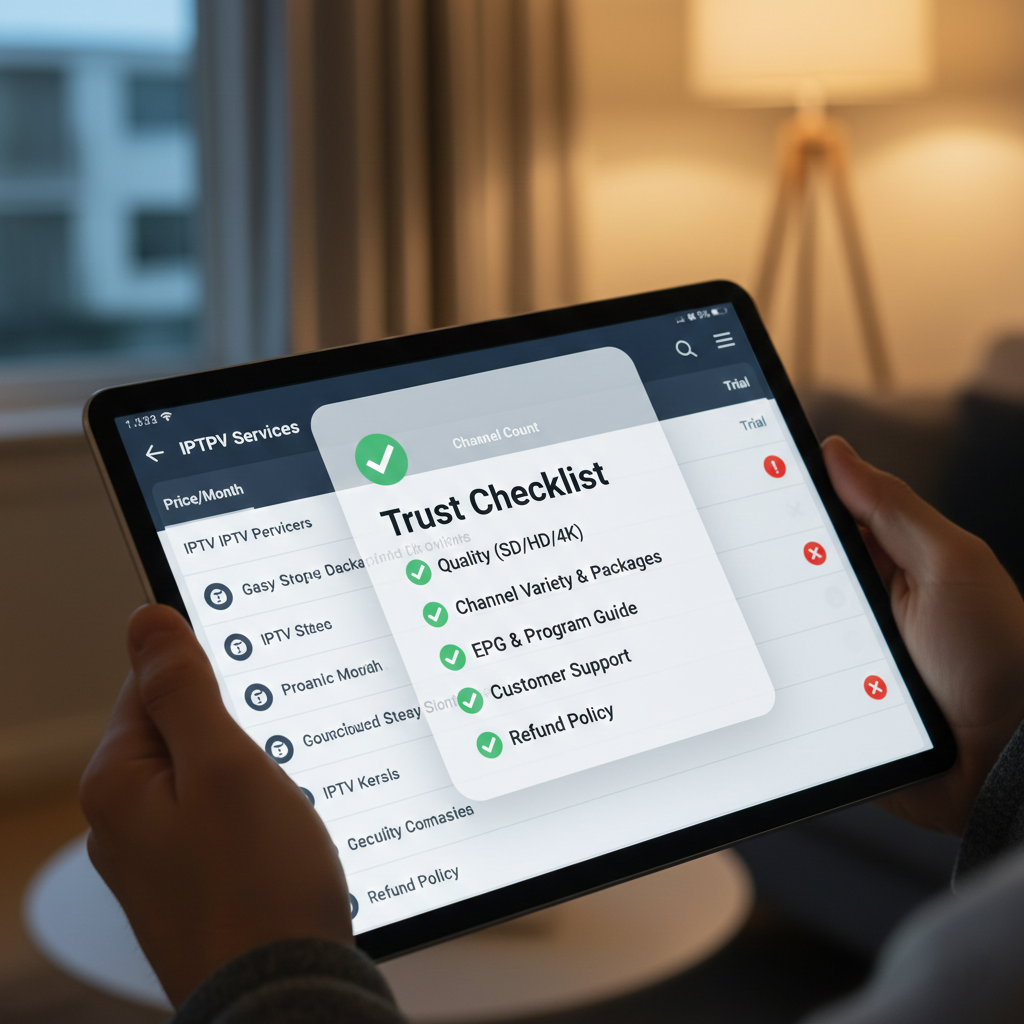
7-point checklist for choosing the right IPTV subscription
The easiest way to choose the right IPTV subscription is to stop comparing providers by hype and start comparing them by seven practical checks. Most users don’t fail because they picked “the wrong brand” — they fail because the service is unstable at night, doesn’t work well on their device, or offers poor support when something breaks. This checklist is designed for non-technical users in Spain and Europe who want something simple, stable, and worth the money.
- Stability at peak hours: test in the evening and on weekends. A provider that looks perfect in the morning can fail completely during match time.
- Channel relevance: verify the Spanish channels you actually watch, not the total channel count.
- Sports reliability: if you watch football or live events, test during real event times. Sports is where weak services collapse.
- EPG quality: the guide should load, update, and display correct schedules. Without it, IPTV becomes frustrating to use.
- Device support: confirm it works smoothly on your exact setup (Firestick, Android TV, Smart TV, mobile). “Supported” is not the same as “runs well.” Best IPTV Apps for Spain (2026): Firestick, Android & Smart TV
- Trial or short plan: monthly access is safer than yearly until the service proves itself.
- Support and transparency: ask one question before paying and judge the reply. If support is slow or vague, it will be worse after payment.
A practical example: a family in Spain with a Firestick in the living room and a Smart TV in the bedroom should test the service on both devices, check EPG performance, and watch live channels during peak time. If one device struggles, that doesn’t always mean the service is bad — it may mean the app or Smart TV hardware is the weak point. That’s why device testing is part of the checklist, not an afterthought.
If you follow these seven checks, you avoid the most common regret: paying for a long plan and then discovering the service buffers, the EPG fails, or support disappears. IPTV should feel like a smooth TV experience, not a constant troubleshooting project. A good provider earns your trust through consistency, not big promises.
Quick takeaway:
- Test performance at peak time before committing.
- Choose stability and support over huge channel numbers.
- Start monthly, then upgrade only if it stays reliable.