Best IPTV Spain: Choose a Reliable Spain IPTV Subscription (2026)
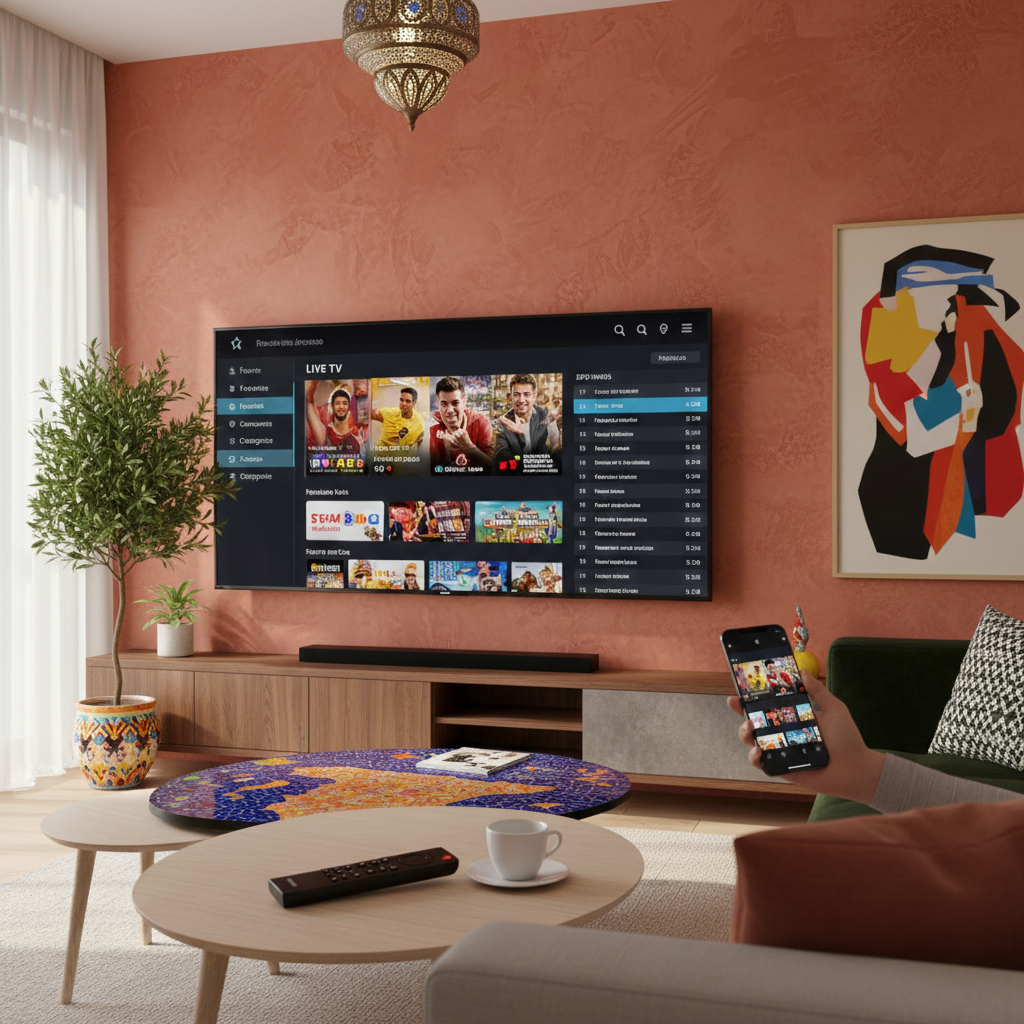
What “IPTV Spain” Really Means (And What You’re Buying)
When people search IPTV Spain, they’re usually not asking for a technical definition — they’re trying to buy a streaming service that works smoothly inside Spain and includes the channels they actually care about. In simple terms, IPTV means watching live TV and on-demand content through the internet instead of cable or satellite. What you’re really buying is access to a server-based TV library that you watch through an app on your Firestick, Android TV, Smart TV, or mobile.
A good way to understand it is to think of IPTV as three parts working together. First, the content: Spanish channels, sports, movies, and sometimes international options. Second, the app: the IPTV player you install on your device, which controls how easy it is to browse channels, use the EPG, and play VOD. Third, the quality of the provider’s servers: this is what decides whether you get smooth streaming or constant buffering. Most beginner mistakes happen because people only look at the channel list and ignore the app and server quality.
A realistic example: a household in Valencia wants Spanish live channels, football on weekends, and movies for the family. They install an IPTV app on a Firestick and expect it to work like Netflix. If the provider is good, it will: fast channel loading, a working guide, and stable streams. If the provider is low quality, the same setup becomes frustrating — channels freeze during peak time, the EPG won’t load, and support is slow. That’s why “Spain IPTV” searches are often about reliability, not just content.
Before you pay, the smartest decision is to check what you’re actually receiving. Does the service include a trial or monthly plan? Does it work on your exact device? Does the provider explain setup clearly for non-technical users? And most importantly: does it stay stable in the evening, when everyone in Spain is watching? If you treat IPTV like a real product — not a gamble — you’ll avoid most of the common regrets.
IPTV Spain vs Spain IPTV: what users actually want
IPTV Spain and Spain IPTV are two ways of searching for the same thing, but they often reveal different user intent. When someone types IPTV Spain, they are usually looking for a service that works well inside Spain: stable streaming, Spanish channels, and compatibility with common devices. When someone searches Spain IPTV, they are often closer to the purchase decision and want a direct recommendation, a price, or a provider that feels “made for Spain.” The wording changes, but the goal is the same: a smooth TV experience without technical stress.
A simple real-world example: a user in Madrid wants to replace expensive TV packages and watch live channels on a Firestick. They’ll often start with IPTV Spain because they want to understand what it is, what they need, and whether it works reliably. Another user living in France but spending half the year in Spain might search Spain IPTV because they already know what IPTV is — they just want a subscription that works across Spain and Europe, with Spanish sports and entertainment included.
What users actually want, in both cases, comes down to a few practical outcomes. They want fast activation, stable streaming during peak hours, and a service that works on Firestick, Android TV, and Smart TVs without constant buffering. They want a working EPG so browsing channels feels normal. And they want the channel list to match real viewing habits: Spanish channels, sports, movies, and international options — not a chaotic list with thousands of duplicates.
A helpful tip is to ignore the keyword variation and focus on the service quality signals. The best providers make setup simple, offer a trial or short plan, and provide real support when something goes wrong. If a service looks professional but avoids trials, promises “perfect 4K everywhere,” or cannot explain setup clearly, it usually means the experience will be disappointing. Whether you search IPTV Spain or Spain IPTV, the smart choice is the same: pick a service that is stable, transparent, and built for real users — not marketing.
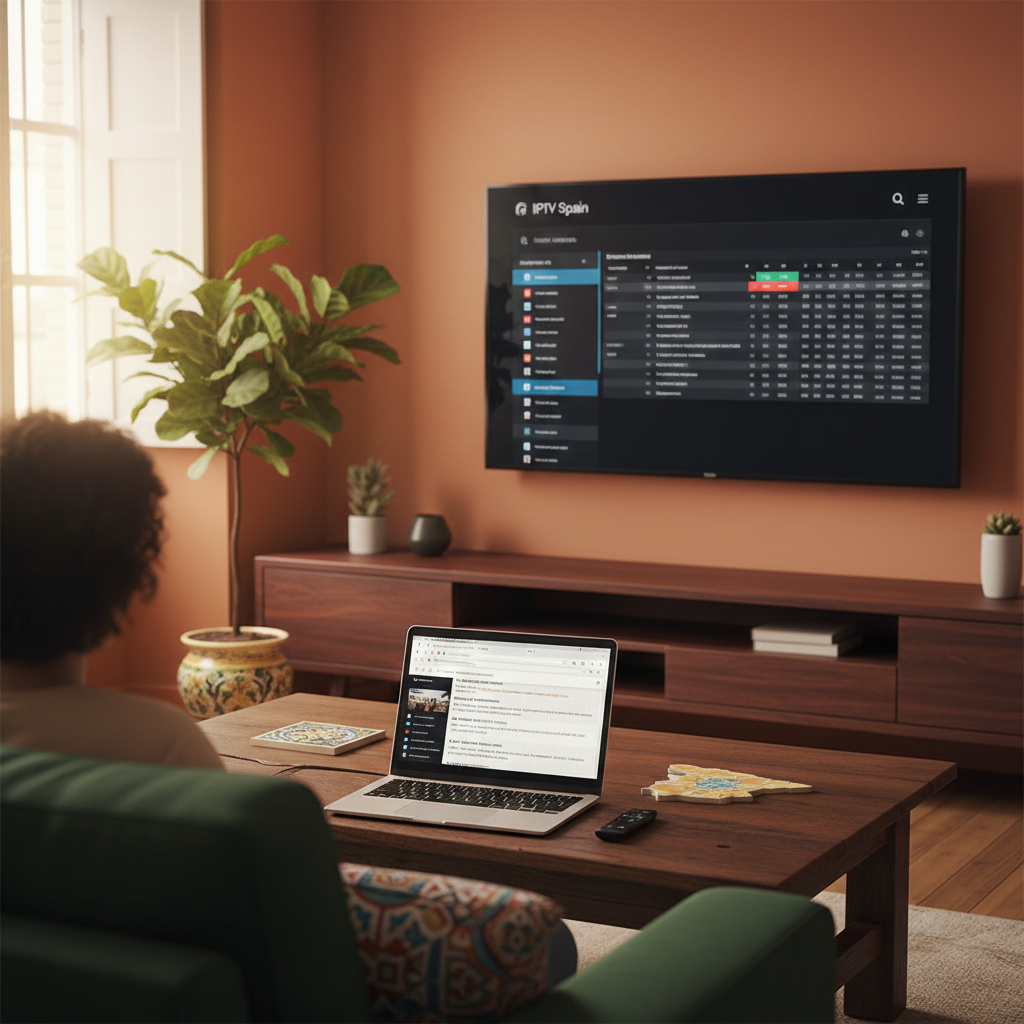
Streaming quality, Spanish channels, EPG, and device support
If you want a Spain IPTV service that actually feels premium, you need four things to work together: stable streaming quality, relevant Spanish channels, a reliable EPG, and full device support. If one of these fails, the whole experience becomes frustrating. Most complaints about IPTV are not about price — they are about buffering during live sports, missing channels, broken program guides, or apps that crash on Smart TVs.
Streaming quality is the foundation. A good service should load channels quickly, switch smoothly, and stay stable during peak evening hours in Spain. Labels like “HD” or “4K” mean very little if the stream freezes during a football match. A practical way to test quality is simple: watch live TV for 20–30 minutes during a busy time, switch between channels, and check if the image stays consistent. If buffering only happens on one channel, it may be a source issue. If everything struggles, the provider’s servers or your network setup could be the problem.
Spanish channels are the second pillar. Instead of chasing huge numbers, confirm that the channels you actually watch are included and stable. National broadcasters, regional channels, and sports coverage are usually the priority for households in Spain. For families or expats, international options also matter. The best services organize content clearly, with clean categories instead of endless duplicated channel lists. A tidy structure is often a sign of a more professional provider.
The EPG (electronic program guide) is often underestimated, but it defines daily usability. Without a working guide, IPTV feels chaotic. The schedule should load quickly, update correctly, and match the channel content. Device support is equally important. Many users stream on Firestick, Android TV, or Smart TVs, and not every app performs equally well on each device. Before committing to a long plan, confirm that the service works smoothly on your exact setup. Stability on one device does not guarantee stability on another.
Quick decision rule:
- Test during peak hours.
- Confirm real Spanish channels you watch weekly.
- Check EPG loading and accuracy.
- Verify performance on your actual device.
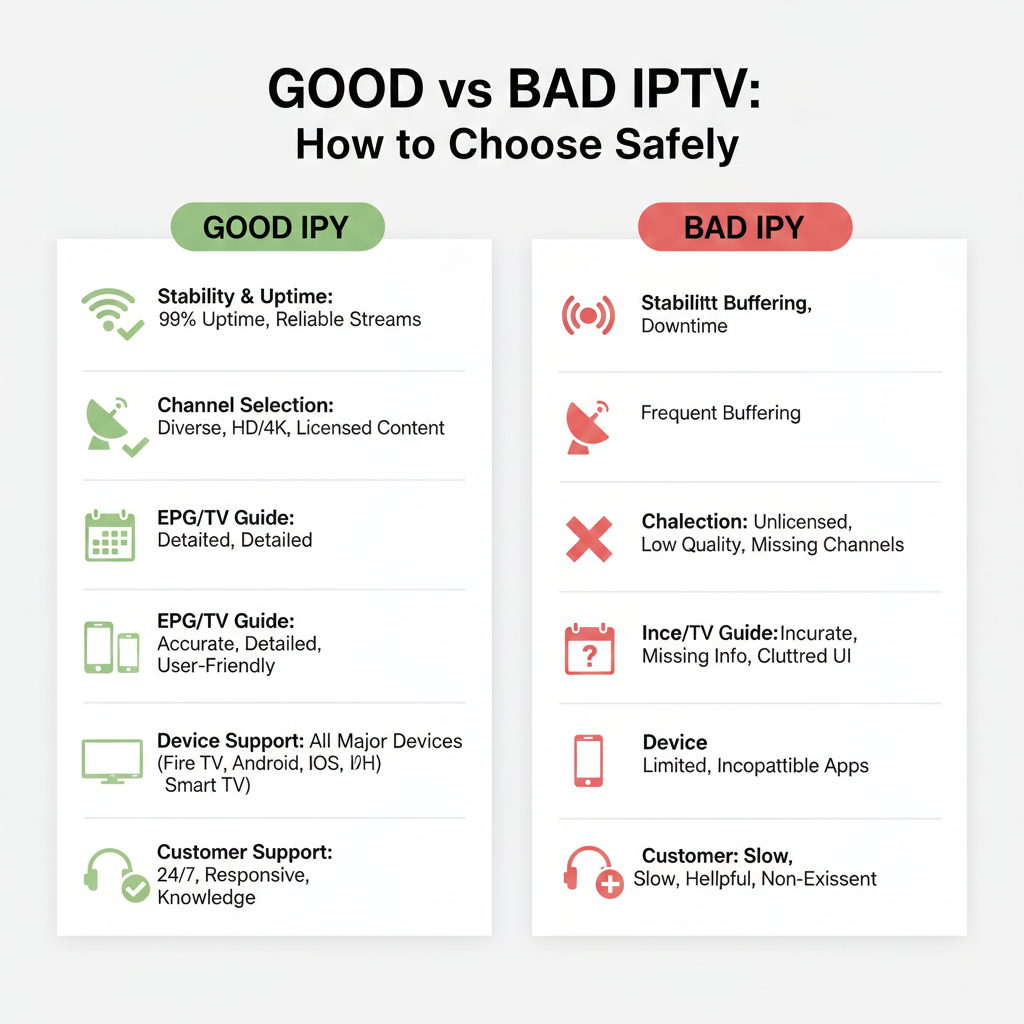
Red flags to avoid before you pay
Before you pay for any IPTV service, you should watch for a few clear red flags that usually lead to wasted money and a frustrating experience. Most low-quality providers look professional on the surface, but they fail in the same predictable ways: buffering at peak hours, channels disappearing, EPG issues, and support that stops replying once you’ve paid. If you know what to look for, you can avoid 90% of the bad options without needing technical knowledge.
The first red flag is unrealistic promises. If a provider claims “zero buffering,” “perfect 4K on every channel,” or advertises massive numbers like “30,000 channels + 200,000 VOD,” treat it as marketing, not proof. In real usage, streaming depends on server capacity, peak-time demand, and the quality of the IPTV app on your device. The best services don’t need exaggerated claims — they prove quality through stable performance and clear communication.
The second red flag is poor transparency around trials, refunds, and support. A serious provider should offer a trial or at least a short monthly option. If they push you into a long-term plan immediately, refuse any testing, or avoid answering basic questions about Firestick, Android TV, or Smart TVs, it’s a bad sign. Support matters more than most users expect, because even good IPTV services occasionally need quick fixes. If support feels slow or vague before payment, it will usually be worse after.
The third red flag is risky payment behavior and aggressive selling. Be careful with providers that only accept unusual payment methods, change prices depending on your responses, or pressure you with fake urgency like “only today” or “last accounts available.” A premium service should feel calm and predictable. A practical tip is to ask one simple question before paying — for example: “Does the EPG load reliably in Spain on Firestick?” If the reply is copy-pasted, unclear, or delayed, you already have your answer.
Quick takeaway:
- Avoid hype, test performance, and trust consistency.
- Monthly access is safer than yearly until the service proves itself.
- Support quality is a dealbreaker, not a bonus.
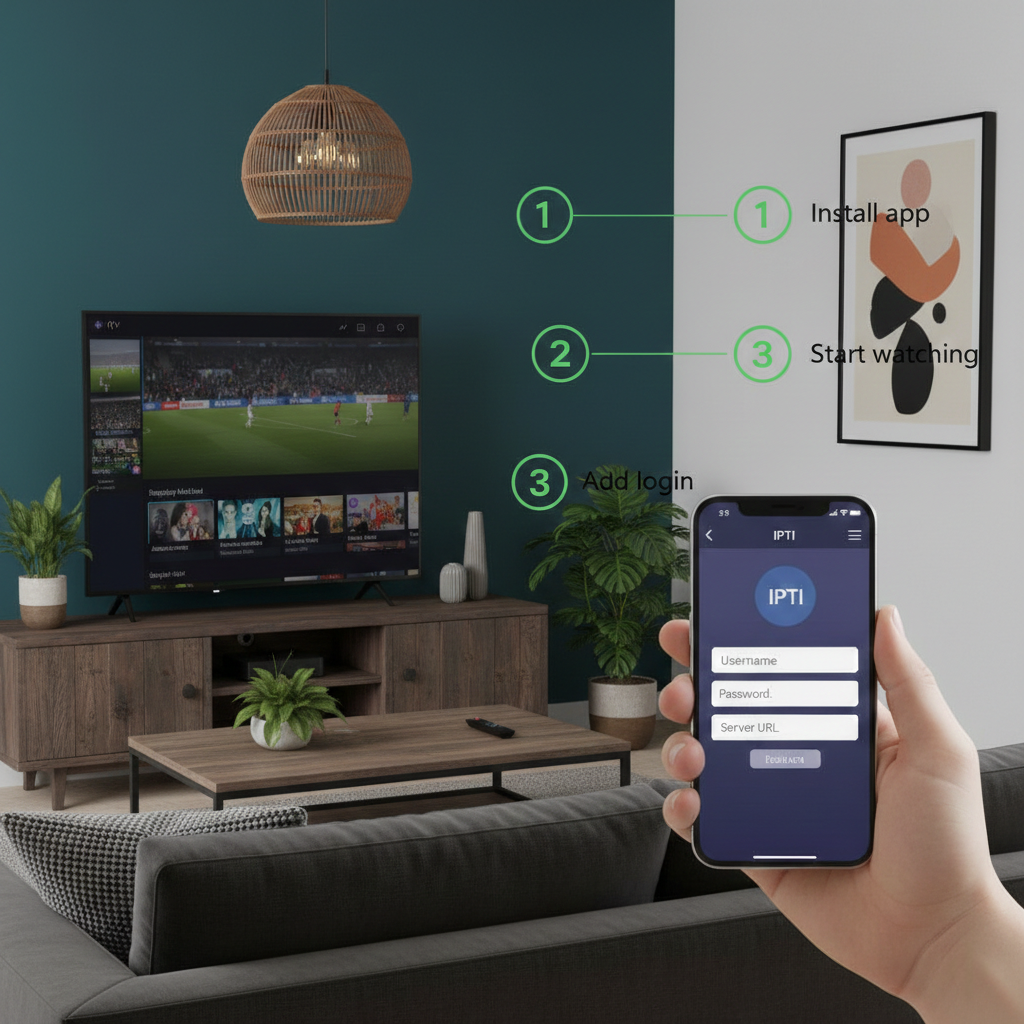
Spain IPTV Setup: Firestick, Android TV, and Smart TVs
Setting up IPTV in Spain is usually simple if you choose the right device and follow a clear order: install a stable IPTV app, enter your subscription details, and test streaming quality before relaxing on the sofa. Most problems don’t come from “complex technology,” but from using the wrong app on the wrong device or skipping basic performance checks. The goal is not just to make it work once — it’s to make it work reliably every evening.
Firestick is the most popular option for many households because it’s affordable, fast, and compatible with most IPTV apps. The setup process is typically straightforward: download an IPTV player, enter your login (username/password or playlist link), let the channels and EPG load, and test a few live channels. A practical tip is to restart the device once after installation and check performance during peak hours. If everything runs smoothly on Firestick, you already have a strong base for a stable viewing experience.
Android TV and Android boxes offer more flexibility. They are ideal for users who want smoother playback options or the ability to switch between different IPTV players. If one app feels unstable, Android makes it easy to test another without changing your subscription. This flexibility is useful when you want to optimise streaming quality or solve EPG issues. For families in Spain who stream daily, Android TV can provide a slightly more powerful and customizable setup than basic Smart TV apps.
Smart TVs can work well, but results vary depending on the brand and operating system. Some newer models handle IPTV apps smoothly, while older TVs may struggle with loading speed, EPG updates, or channel switching. If your Smart TV feels slow, adding a Firestick or Android TV device often improves performance significantly. A simple rule: if IPTV feels unstable on your TV, test the same subscription on another device before blaming the provider. Device limitations are more common than most users expect.
Quick setup checklist:
- Install one reliable IPTV app (don’t mix multiple players at once).
- Enter login details carefully and check EPG loading.
- Test live channels during peak time.
- Optimise Wi-Fi (5GHz if possible, router nearby).
Fast setup overview (non-technical)
Setting up IPTV is usually quick and simple if you follow a clear three-step process: install the right app, enter your subscription details, and test the stream properly. You don’t need technical skills, coding, or complicated network changes. Most users in Spain can complete the setup in 10–15 minutes, especially on common devices like Firestick, Android TV, or newer Smart TVs.
First, choose one reliable IPTV app for your device. Don’t install three different players at once — that often creates confusion. After installation, you’ll receive login details from your provider. This is usually either a username and password or a playlist link (URL). Enter the information carefully, double-check for typing errors, and allow the app to load channels and the EPG. If the channel list appears clean and organised, you’re already on the right track.
Next, test properly instead of assuming everything works. Open several live channels, switch between them, and watch for at least 10–20 minutes. Try one sports channel if possible, because live sports is where weak servers often show problems. Then check the EPG: does it load quickly? Does it show correct program information? These small checks prevent surprises later. Many IPTV problems reported in Spain happen because users skip this initial testing phase.
Finally, optimise your home setup. Keep your streaming device close to the router, use 5GHz Wi-Fi if available, and avoid heavy downloads while watching live TV. If your Smart TV feels slow, consider using a Firestick or Android TV device instead — they often handle IPTV apps more smoothly. The goal is not just to make IPTV work once, but to make it feel stable and effortless every evening.
Quick setup summary:
- Install one stable IPTV app.
- Enter login details carefully.
- Test live channels and EPG.
- Optimise Wi-Fi for stable streaming.
Before You Buy: Final Checklist
Before you buy any IPTV service, you should take two minutes to check the things that decide whether the experience will be smooth or frustrating. Most people don’t regret IPTV because of the price — they regret it because the service buffers during peak hours, doesn’t work well on their device, or becomes impossible to use when the EPG fails. A short checklist protects you from the most common mistakes and helps you choose a provider that actually fits your home in Spain.
Start with performance, because this is the real “quality test.” If the provider offers a trial, use it in the evening and on weekends, not just in the morning. Watch a live channel for 15–20 minutes, switch channels quickly, and check whether the stream stays stable. If you care about sports, test during real match times. This is where weak services collapse, even if they look fine during quiet hours. If there is no trial and the provider pushes you into a yearly plan, treat that as a warning sign.
Next, check usability: your device, the IPTV app, and the EPG. Many users in Spain watch on Firestick, Android TV, or Smart TVs, and not every service runs well on every setup. Confirm that the service works smoothly on your exact device and that the app feels stable. Then check the program guide: does it load, update, and show correct schedules? Without a working EPG, IPTV becomes annoying fast, especially for non-technical users who just want to browse and watch like normal TV.
Finally, check transparency and support. Ask one simple question before paying — for example, “Does this work well on Firestick in Spain, and is the EPG reliable?” A good provider will answer clearly and quickly. A bad provider will reply vaguely, copy-paste generic lines, or pressure you to pay immediately. If support feels weak before payment, it will almost always be worse after. A premium service should feel calm, clear, and predictable.
Quick checklist:
- Trial or monthly option available
- Stable streaming at peak time
- Spanish channels you actually watch
- Sports streams tested during events
- EPG loads correctly
- Works well on your device
- Support responds clearly before payment
7-point checklist for choosing the right IPTV subscription
The easiest way to choose the right IPTV subscription is to stop comparing providers by channel numbers and start comparing them by real-world performance and usability. Most users don’t have technical knowledge, and they shouldn’t need it. A good IPTV service should feel like a normal TV experience: fast loading, stable streaming, and simple navigation. This 7-point checklist helps you avoid the most common mistakes and choose a service that works well in Spain and across Europe.
- Peak-time stability: test the service in the evening and on weekends. A provider that looks smooth in the morning can buffer badly at night.
- Spanish channel quality: confirm the Spanish channels you actually watch, and check if they load quickly without errors.
- Sports reliability: if football or live events matter, test during real match times. Sports is the fastest way to expose weak servers.
- EPG performance: the guide should load, update, and show correct schedules. Without EPG, IPTV becomes frustrating and messy.
- Device compatibility: make sure it runs well on your exact device (Firestick, Android TV, Smart TV, mobile). “Supported” does not always mean “stable.”
- Trial or monthly plan: start short-term before committing. A monthly plan is safer than a yearly plan until the service proves itself.
- Support and transparency: ask one clear question before paying and judge the response. If support is vague or slow now, it will be worse later.
A practical example: a family in Spain might use a Firestick in the living room and a Smart TV app in the bedroom. The service may work perfectly on the Firestick but crash on the Smart TV, not because the provider is terrible, but because Smart TVs vary widely in performance. Testing on your real devices is part of choosing smart, not an extra step. The same is true for EPG: it can work in one app and fail in another, so app choice matters.
If you follow this checklist, you protect yourself from the most common regret: paying for a long plan and then discovering the service buffers, the EPG fails, or support disappears. IPTV should save time and money — not create weekly problems.
Quick takeaway:
- Test at peak hours before paying long-term.
- Choose stability and support over huge channel lists.
- Start monthly, then upgrade only after consistent performance.